The European Union (EU) has extended its Generalised Scheme of Preferences (GSP) trade initiative for another decade in a move set to broaden access for Malawi and 45 other countries to the world’s largest export market.
Under the new regulation covering 2026–2036, the Everything But Arms tariff line will take effect on January 1 2027.
The extension comes as Malawi emerges among the fastest-growing users of the scheme, which grants developing countries preferential access to the EU by reducing or eliminating import duties.
Malawi recorded a 19 percent increase in GSP utilisation between 2022 and 2024, driving a 13 percent rise in exports to the EU, according to a statement.
Key product categories benefiting from the scheme include clothing, footwear, fish and chemical products.
In a joint statement, the European Commission and the High Representative for the Common Foreign and Security Policy said the GSP remains a source of stability and predictability in times of geopolitical volatility.
Reads the statement in part: “Beyond its trade and economic benefits, GSP remains an attractive and effective incentive for sustainable development in beneficiary countries in the areas of human rights, labour rights, environmental and climate-related issues, rule of law, drug control and anti-corruption.”
EU data show that between 2022 and 2024, Benin recorded the highest growth in the use of GSP preferences, with a 128 percent increase, from euro 5.1 million (about K12 billion) in 2022 to euro 11.7 million (about K28 billion) in 2024 while Malawi ranked second, with a 19 percent increase over the same period, contributing to a 13 percent rise in its total exports to the EU.
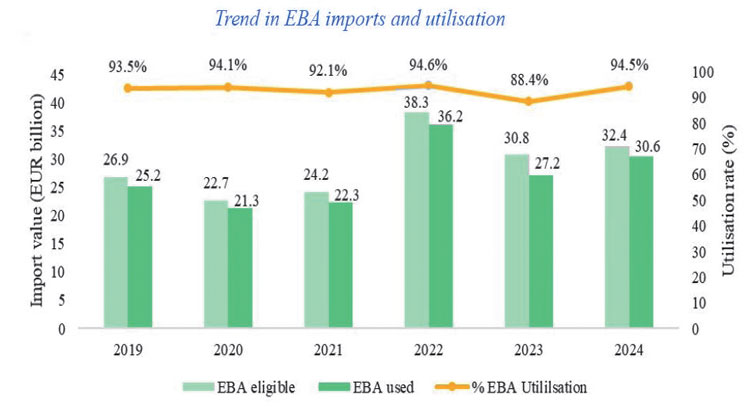
The data further show that preferential imports from EBA beneficiaries stood at 30.6 billion euro (about K74 trillion) in 2024, up from 25.2 billion euro (about K61 billion) in 2019.
The utilisation rate of the EBA preferences was at 88.9 percent in 2024, showing an increased use of the preferences by African beneficiaries over the past years, but also potential to do more, according to the EU.
In an interview, Asia-based Malawian economic statistician Alick Nyasulu said that the tough business environment makes it difficult for Malawi to fully utilise its trade agreements.
“It is important that manufacturers take steps to appreciate that the needs of foreign markets are tough,” he said.
Ministry of Industrialisation, Business, Trade and Tourism Principal Secretary Wiskes Nkombezi said while GSP schemes are fundamental instruments for increasing exports, Malawi needs to address issues of tariffs, stringent rules of origin and non-tariff barriers.
Data from GSP EU hub show that almost all EU imports from Malawi are eligible for EBA preferences. The value of eligible imports has fluctuated over the years with an overall decreasing trend, but since 2020 imports have increased again, reaching 260 million euro in 2024.
With a preference utilisation rate consistently above 99 percent in 2024, Malawi belongs to the countries which take the biggest advantage from the GSP across all three arrangements.
Malawi’s trade with the EU remains modest, but strategically important with agricultural products taking up to 99 percent of Malawi’s exports to the EU and tobacco accounting for the bulk, according to the National Statistical Office.
On the the other hand, about 95 percent of EU exports to Malawi are industrial products, including machinery, chemicals and paper products.